
In the latest bid to build a new Chicago Bears stadium on the lakefront, developers and city officials pitched a $10 billion plan for a new domed development at the site of the closed Michael Reese Hospital.
The plan is being pitched by Capri Investment Group and GRIT Chicago, with support from 4th Ward Ald. Lamont Robinson, who represents the ward where the proposed complex would be built.
Developers have proposed using the Reese Hospital site for a new Bears stadium previously, since the team made it clear they planned to move out of Soldier Field. But the Bears had rejected those proposals, saying the 48.6 acre site is too narrow and commuter train tracks presented engineering challenges.
Developers say now they have a much bigger vision for the property, expanding beyond the original hospital site to make room for a stadium and an entire new South Side district.
And the developers said that if the Bears' ownership of the Arlington Heights property on which they had originally planned to build a new stadium is the impediment to keeping the Bears in the city, they will buy it.
"Moreover, and this is important so listen to me carefully, if the fact that the Bears ownership of Arlington Heights is the key impediment to the team staying downtown and fairly considering Bronzeville, our global investors that we have signed with, and I, and our team, are prepared to buy the Arlington Heights site and eliminate this conflict," said Quintin E. Primo, III, founder and executive chairman of Capri Investment Group, at a Thursday morning news conference.
But what they don't have yet it a detailed plan, including answers about money.
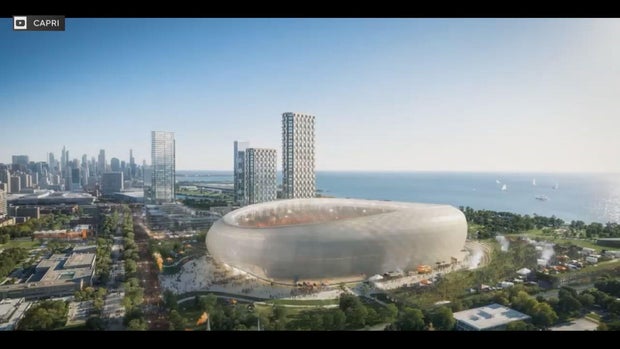
This new vision is called Bronzeville Lakefront, and the plan calls for transforming approximately 100 acres including and surrounding the former Reese Hospital site, with a new domed football stadium at its center that would hold approximately 75,000 spectators and be 1.8 million square feet.
Developers said the stadium would not just be able to host the Bears, but also other major sporting events, concerts and other national attractions.
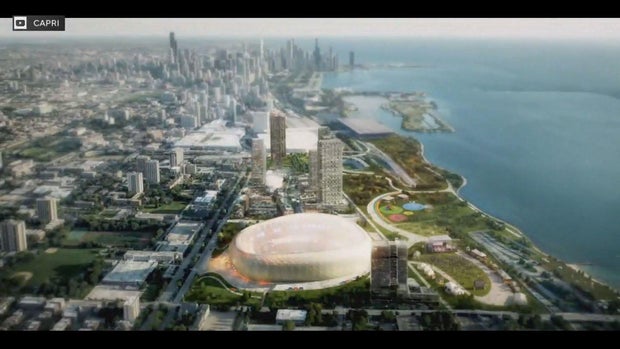
Around the stadium, they propose building extensive new mixed income housing that would include affordable, senior, workforce and student housing options. They also propose commercial development, expanding and connecting McCormick Place to the project, a new 28 acre park with a land bridge over DuSable Lake Shore Drive, new shops and restaurants, 400,000 square feet of new offices, a new health and wellness center similar to East Bank Club, parking facilities, other retail and commercial space and more.
To do this, they want to expand beyond the hospital property and take over the nearby Prairie Shores apartment complex and build over the McCormick Place truck marshaling yard using air rights. It's a key detail that still needs to be prove with a detailed site plan and engineering review.
"Therefore there should be no reasons why the Bears and the NFL should not seriously consider Bronzeville as the best site for their new home," Primo said.
Developers expect it would produce 60,000 new jobs and at least $14 billion in regional economic benefits.
But there's also a significant impact for people who already live here.
Developers said that unlike other proposals for the former hospital property, their revised Bronzeville Lakefront proposal is an overall investment in the city's South Side communities. But the proposal could mean displacing all the people who live in the more than 1,000 apartments at Prairie Shores.
"That's an issue that has to be addressed," said Cook County Commissioner Bill Lowry. "They're prepared to do so."
"Our vision is to make the Bears a catalyst for new housing, jobs, businesses and economic opportunity that will benefit Chicago long after the final whistle blows," said Primo in a news release announcing the plan.
Primo argued the site provides a more central and accessible location with better public transit options, providing the lakefront benefits of Soldier Field with less traffic and congestion; would allow expansion for McCormick Place Convention Center; would generate more income for the Chicago Park District through a new 28-acre park that would also be a site for Bears fan tailgating; would generate economic benefits for the surrounding community and connect it to the Obama Presidential Center and Illinois Quantum Park further south; and would generate thousands of new jobs for Chicagoans.
The developers said their new vision also addresses objections previously raised about whether a Bears stadium could fit on the Reese Hospital site. They said their preliminary designs show the stadium would require 30 to 40 acres, including a 300 foot security perimeter needed to host a Super Bowl, which they said could be accommodated without encroaching on current active railroad operations in the area.
They also said the development would reconnect historically separate parts of the South Side through the construction of new east-west streets, pedestrian connections and the land bridge over DuSable Lake Shore Drive.
So who is fronting the bill? The developers say the stadium would be owned by the public and the Bears would help pay for it. That could include a large up-front lease payment, using money from things like stadium naming rights and personal seat licenses.
The plan also looks to NFL loans and possible state bonds. Taxpayers would help cover the roads, transit and other infrastructure through city, state and federal funding, which could include Tax Increment Financing and bonds backed by sales tax revenue.
And another big bill could come due if the Bears take them up on the offer to buy the Arlington Heights property.
"This relieves them of that sunken cost and allows them to reconsider an area right here near downtown in Bronzeville on the South Side," said State Sen. Robert Peters.
The investors did not directly answer a question about whether developers had met with the Bears or even Mayor Brandon Johnson about the proposal.
In a statement, Johnson didn't confirm that either, but said in part, "Developers know that all ideas will be vetted thoroughly and advancing their ideas will require community engagement and support."
The Bears have said they are focused on possible stadium sites in Arlington Heights, Illinois, and Hammond, Indiana, but that hasn't stopped developers in the city from pitching more plans for lakefront stadiums.
Related Midwest pitched a Bears stadium site at the former U.S. Steel South Works site along Lake Michigan, near the Illinois Quantum and Microelectronics Park quantum campus at 87th Street and DuSable Lake Shore Drive.
In late October, Crain's Chicago Business reported that lawmakers in Springfield could vote in November during their veto session on legislation to make it easier for the team to build a stadium in Illinois. They cited momentum from an Oct. 1 meeting in Chicago between NFL Commissioner Roger Goodell, Gov. JB Pritzker, Illinois legislative leaders and Bears minority owner Pat Ryan.
CBS News Chicago has reached out to the Chicago Bears for comment on this new proposal and are waiting to hear back.


