
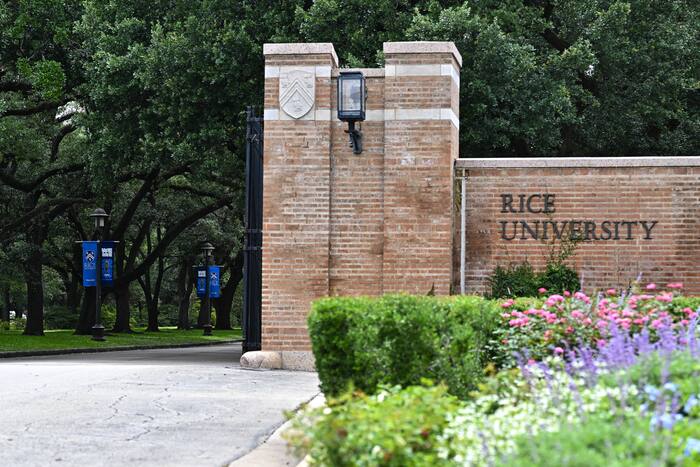
HOUSTON — Rice University is one of 30 schools named in a civil rights complaint filed with the U.S. Department of Justice by the Equal Protection Project — a group that challenges what it considers racial discrimination in education. The complaint centers on a graduate school pipeline program, and it’s raising eyebrows across higher education.
But here’s what you need to know upfront: Rice has not been accused of specific wrongdoing, and no discrimination has been proven.
At the center of it all is the Institute for Recruitment of Teachers (IRT) — a program founded in 1990 to help more Black, Hispanic, and Native American students pursue advanced degrees and careers in education. In 2004, IRT opened its doors to students of all racial backgrounds who support its mission.
Today, IRT helps students prep for graduate school and connects them with universities. Its own website notes that 93% of its 2026 participants identify as people of color.
Rice’s graduate admissions website references IRT as an organization whose participants may qualify for application fee waivers — establishing a relationship between the university and the program.
The question the Equal Protection Project is asking: Is that relationship being used to give certain applicants a racial edge in admissions?
William Jacobson, founder of the Equal Protection Project, put it plainly:
“Is this IRT consortium a means that schools can do indirectly what they’re not allowed to do directly, which is take race into account when admitting students?”
Jacobson argues that even though IRT technically accepts applicants of every race, the way it markets itself could discourage white students from even trying.
He’s also been upfront about the limits of what his group actually knows. They haven’t reviewed any university’s private admissions files. They haven’t identified a single student who was denied admission because of IRT. And they’re not claiming Rice specifically broke the law.
“We have not accused Rice of any specific wrongdoing,” Jacobson said. “But that consortium promotes entry into graduate school programs on the basis of race or ethnicity.”
Their ask? Let federal investigators dig in and find out.
In June 2023, the Supreme Court struck down race-based affirmative action in college admissions, ruling that the systems used by Harvard and the University of North Carolina violated federal equal protection requirements.
The bottom line: Universities generally cannot give an applicant an admissions advantage simply because of their race.
But the ruling wasn’t a blanket ban on considering a student’s background. Schools can still factor in how a student’s personal experiences — including experiences involving race — shaped who they are, what they’ve overcome, and what they bring to campus.
Cory Liu, an adjunct constitutional law professor at the University of Texas School of Law, explained the distinction:
“If you’re really getting to know who they are as an individual, that’s one thing — that’s not necessarily discriminating. You’re not choosing one race over another race.”
The legal line, Liu says, is crossed when universities start sorting applicants into racial categories or using outside programs to make race-based decisions they’re no longer allowed to make directly.
For now, this complaint is exactly that — a complaint. It’s a request for federal scrutiny, not proof of a violation.
“It’s just an accusation, it’s a question being raised,” Liu said. “Nothing’s been proven or found to be in violation of the law. It’s just a chance for the government to ask questions, maybe look into some documents.”
The Justice Department must first decide whether to even pursue it. As of his interview with KPRC 2, Jacobson said his group hadn’t received so much as an acknowledgment from the department.
Rice University declined to comment.
If investigators do find a violation, federal officials could push for changes to a university’s admissions practices — or pursue legal action if an agreement can’t be reached.
The heart of this debate comes down to one question: Are universities offering opportunities to a wide range of students — or are they quietly using outside programs to make admissions decisions based on race?
That’s exactly what the Supreme Court said they can’t do in 2023. And it’s exactly what the Equal Protection Project wants the federal government to find out.


